



The school was constructed in 2008 using modular prefabricated units intended for temporary accommodation, with replacement originally envisaged within five years.
Two separate reports completed in 2025 and seen by Kfm News converge on the same stark conclusion about St. Patrick’s Primary School in Celbridge: in its current condition, the building presents a serious and immediate safety concern that extends well beyond routine maintenance issues.
The first is a condition inspection commissioned by the school.
The second is a detailed Emergency Works application prepared by registered architect Martin Noone.
Read together, they describe a temporary modular building showing severe deterioration across its structure, fire protection and building fabric - alongside confirmed evidence of rodent burrows on the site.
The consultant’s core finding sets the tone. The building, he writes, “is not fit for purpose to operate without considerable risk” and “is unsafe and poses a serious immediate threat to the well-being, health and safety of the occupants and users.”
That assessment is repeated in substance across the documentation and is notable for its breadth: it is not tied to a single defect but to the overall condition of the structure.
The most immediately critical issue highlighted across the reports concerns the fire safety strategy, particularly the condition of corridor fire doors.
These doors are designed to compartmentalise a building during a fire and protect escape routes.
The consultant’s finding is unusually blunt: corridor fire doors are “almost without exception… failing badly” due to distortion, hinge wear and defective closers.
Operational testing raised further concerns. Doors fitted with magnetic hold-open devices linked to the fire alarm were found to be failing to close when activated. Others intended to remain closed were being wedged open with timber wedges.
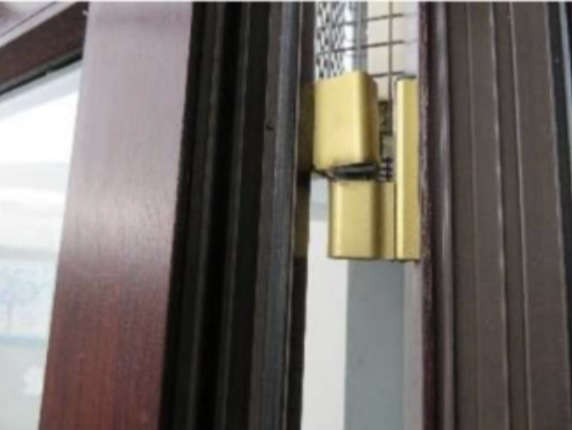
The report’s risk assessment is explicit, warning this represents “clearly a highly dangerous situation with a real threat to the lives and safety of the occupants and users.”
From a building safety perspective, this is significant because it indicates not just wear and tear but a breakdown in the building’s primary passive fire protection system.
The report stated that a “full review of the overall system including emergency and escape lighting, must be carried out by a specialist Fire Protection Systems specialist, and upgrade to current standards and regulations as required. All existing original emergency and escape lighting to be replaced with modern compliant fittings.”
The floor plate: “catastrophic failure”
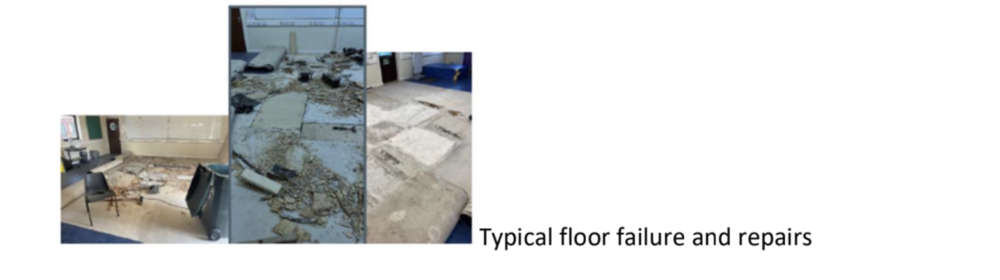
Running alongside the fire concerns is a structural issue described in equally strong terms. The ground floor construction - a suspended plywood floor plate above a concrete raft - is reported to be “rotting and failing in multiple locations.”
Inspectors record that floor collapses have already occurred.
In some areas, they warn, only the vinyl floor covering remains preventing occupants from falling through.
The failures are described as “continuous and ongoing” despite repeated ad-hoc repairs over the years.
That wording is important. It suggests the deterioration is inherent to the original construction rather than the result of isolated damage.
The reports also highlight the knock-on structural effects.
Internal partitions appear to bear onto the compromised floor plate, and deformation of the floor is already affecting the operation of fire doors and external escape doors. This suggests that two of the building’s most serious risks - structural instability and fire door failure - are interacting.
Moisture: the underlying driver
A consistent theme throughout the documentation is water.
Inspectors recorded multiple instances of roof and ceiling leaks, rust staining on external cladding and what is described as “significant and serious condensation” producing substantial quantities of water within roof areas.
Externally, surface water is noted to be accumulating around the building.
The consultant identifies this as likely contributing to wet and damp conditions beneath the structure and to the ongoing ground-floor failures.
Taken together, the reports point to a moisture management problem affecting the building envelope, roof space and subfloor environment.
Just last month, Kfm News revealed how a leak forced the closure of a Junior Infants classroom at the school, with pupils sent home.
Rodent burrows: formally recorded on site
One of the more striking additions in the Emergency Works submission is the explicit reference to vermin activity.
The consultant records “rodent burrows visible in several locations, at gullies, drains etc,” and recommends that the holes be filled with rapid-set concrete and that areas beneath the building be checked when floor works are undertaken.
The reports do not state that rodents are present inside classrooms, and they stop short of describing an infestation within the building.
However, the formal identification of burrows around the drainage infrastructure confirms active ground disturbance around the structure.
Building services under strain
Beyond the headline structural and fire issues, the documentation points to wider systems fatigue.
The heating installation is described as defective and “constantly failing,” with replacement recommended.
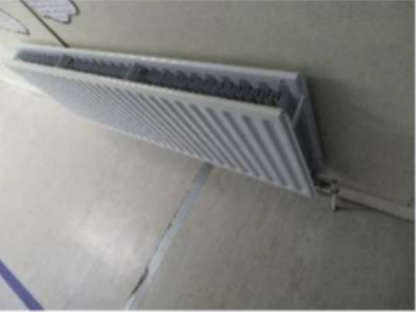
Several radiators have become detached from walls and require upgraded fixings.
The consultant also calls for full specialist reviews of the electrical installation, plumbing systems and fire detection and alarm system.
“Given a number of radiators have become detached from walls, selective opening up should be made to determine the status of bearing elements/grounds and strengthen as required,” the report stated.
Individually, each of these might be manageable through targeted upgrades. Collectively, they reinforce the picture of a building whose core systems are ageing at the same time.
A temporary building reaching its limits
Context is critical to understanding the severity of the findings.
The reports detail how the school was constructed in 2008 using modular prefabricated units intended for temporary accommodation, with replacement originally envisaged within five years. The consultant explicitly notes that the construction standard used at the time does not compare with modern permanent modular school systems.
It is now approaching two decades in continuous use.
The scale of the prescribed fix
The clearest indicator of the seriousness of the situation is the scope of the recommended works.
The consultant does not propose limited patch repairs. Instead, the reports call for:
- Total replacement and upgrade of the ground floor plate
- Immediate replacement of corridor fire doors and frames
- Opening-up of roofs and walls to investigate hidden defects
- Specialist structural investigations
- Comprehensive review and upgrade of building services
- Sealing of rodent burrows and inspection beneath the structure
One final detail in the documentation is easy to overlook but important.
The condition report is described as a superficial inspection with no intrusive opening-up of the structure and no access to certain high-level areas. Despite those limitations, the professional opinion is that the building is unsafe.
From a risk perspective, that raises an obvious question: if such conclusions were reached on a non-invasive review, what would a full intrusive survey reveal?
Taken individually, each defect - failing fire doors, floor deterioration, moisture ingress, rodent burrows, ageing services - might be manageable.
Taken together, and viewed through the lens of a temporary building now in its seventeenth year of use, the reports describe something more fundamental: a structure showing multiple, interacting signs of deterioration.
The professional judgement across both assessments is consistent and unambiguous.
In its current condition, the building is unsafe.
The conditions have also been raised in the Dáil by several local politicians.
While just this week, Kildare North Social Democrats TD Aidan Farrelly criticised the Department of Education.
He claimed that problems at St Patrick’s Primary School could no longer be ignored when, just last month, a leak forced the closure of a junior infants class.
“While there are proposals for a permanent school building at the site, the project is at architectural design process within the Department of Education and a new building is not likely to materialise for several years,” Deputy Farrelly said.
He added: “The fact that ground has not yet been broken means the children remain in a ‘temporary' facility that is failing daily. The school community cannot wait several more years for a permanent solution while the current ceiling literally leaks over the children’s desks.”
 Friday's Kfm Obituary Announcements
 New Cultural Programme Set For Castletown House
 Celbridge Woman Who Lost Sister To CF Calls For People To Support Today's Fundraiser
 Protestors, Including Kildare's John Dallon, Refused Entry From Government And Agriculture Bodies Meeting
 Defence Forces Travelling To The Curragh Today For Training
 Newbridge Silverware’s Silver-plated Cutlery Factory Officially Closes
 Martin Heydon Will Meet Farming And Haulier Groups This Morning Amid Fuel Protests
 Missing 17-Year-Old Joshua Treacy From Maynooth Has Been Located